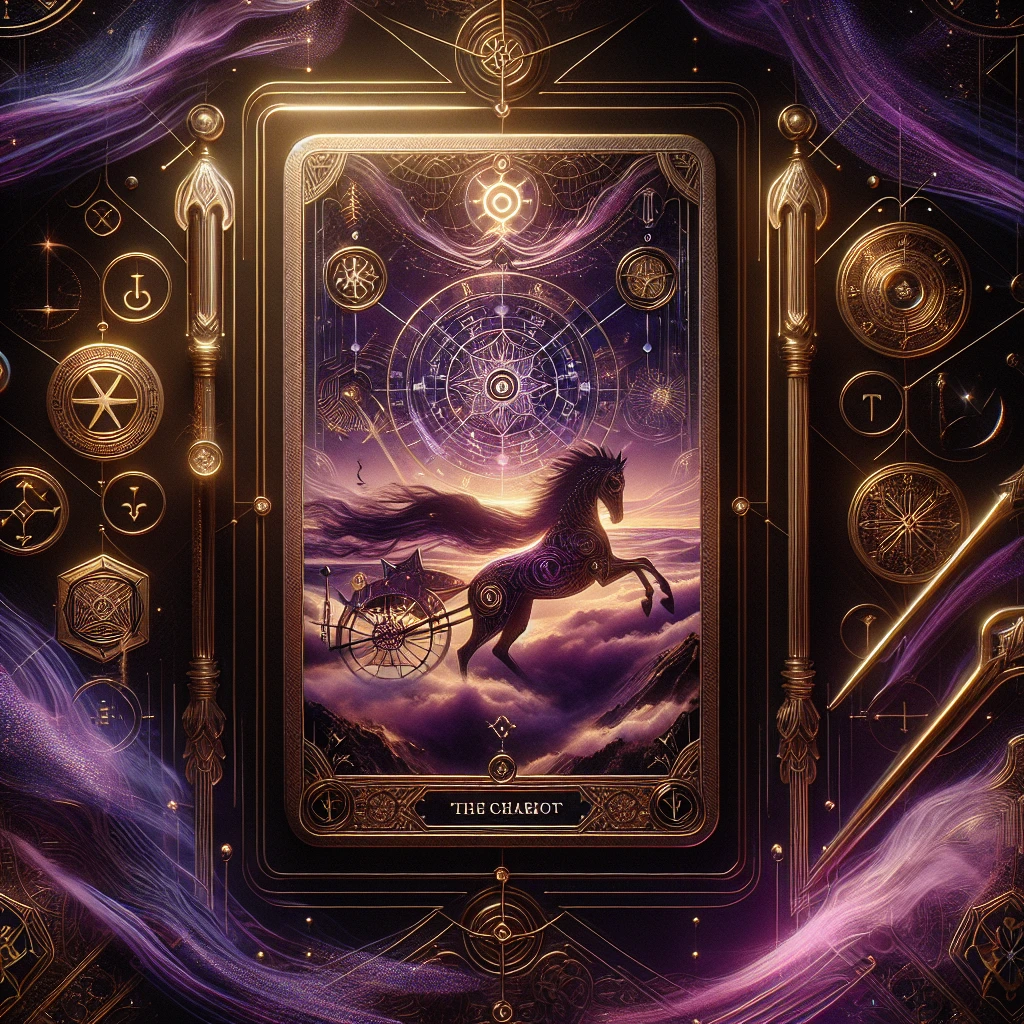
The launch date is fixed, two departments want opposite things, and someone still has to get the product out the door. That kind of directed effort is The Chariot: progress that comes from holding two pulls, often in opposite directions, on a single course through will and focus rather than force. Upright, it means momentum, discipline and a win you earn by staying on track. Reversed, the same energy scatters: you push hard but drift, stall, or let one side of the situation drag the whole thing off the road.
The Chariot upright vs reversed
| Area | Upright | Reversed |
|---|---|---|
| General | Determination, focus, progress, a deserved win | Loss of direction, stalling, forcing things, scattered effort |
| Love | Working through differences on purpose, moving a relationship forward | Power struggles, one partner steering alone, pulling in different directions |
| Career | A push towards a clear goal, a successful launch, leading a team through pressure | Overwork without results, a project pulled apart by competing priorities |
| Money | Disciplined saving or spending with a target, a planned purchase | Impulsive spending, a budget that keeps changing, financial strain from rushing |
| Health | Energy for a structured routine, consistency | Burnout, pushing through when rest is needed |
| Advice | Choose the destination and hold the line | Stop accelerating and decide where you are actually going |
The health row describes energy and habits only. Tarot cannot tell you what is happening in your body, so symptoms belong with a doctor rather than a spread.
Correspondences of The Chariot
Hebrew letter and path. The Golden Dawn gave The Chariot the letter Cheth, meaning "fence" or "enclosure". The image fits: the charioteer is protected and contained by his vehicle, and his power comes from boundaries he chooses. On the Tree of Life the card sits on the path from Binah, understanding, to Geburah, strength, which reads neatly as discipline growing out of comprehension.
Sign and element. The card belongs to Cancer, a Water sign. That surprises people who expect a war card to be fiery, but Cancer is the crab, soft inside and armoured outside. The Chariot's armour protects something sensitive, and the drive behind it is often emotional: protecting home, family, or a hope that matters.
Numerology. Seven is the number of a test after a period of building. In the Major Arcana it follows the choice made in The Lovers (VI) and puts that choice into motion. Seven also carries a sense of effort that has to be renewed again and again rather than settled once.
Place in the Fool's Journey. The Chariot closes the first row of the Major Arcana. The Fool has met teachers, made a choice and now goes out into the world under his own power. It is the first card where the traveller acts as a grown, independent figure, and the next card, Strength, will ask him to replace outer control with inner calm.
Which reversed meaning of The Chariot applies?
The reversed Chariot can mean too little drive or too much of it. Three checks help you tell which one you are looking at.
- Is there a destination? If you cannot name a concrete goal in one sentence, the reversal is about lack of direction. Effort is real, but it has no target.
- Who holds the reins? The RWS charioteer holds no reins at all; the sphinxes move because of his will. If in your situation someone else is setting the pace, or you are reacting to every demand, the card points to a loss of control.
- Are you forcing it? If you have a goal and full control but keep pushing past signs that something is wrong, the reversal warns against aggression and stubbornness. Here the remedy is to slow down, not to try harder.
If more than one check fits, start with the destination: the other two problems usually ease once the goal is clear.
The Chariot in combinations
- The Chariot with The Lovers: a decision is made and immediately acted on. Accepting a job offer and handing in notice the same week fits this pair.
- The Chariot with Strength: willpower balanced by patience. A manager who keeps a tense team on schedule without raising her voice is a good picture of it.
- The Chariot with Eight of Wands: fast movement, travel or a rush of news. A product release moved forward by a month, with everything suddenly happening at once, matches it.
- The Chariot with Two of Pentacles: juggling two obligations while still moving forward. Think of finishing a degree in the evenings while working full time.
- The Chariot with Five of Wands: progress through competition or friction. A tender with several rival bids, where staying focused matters more than winning every argument, suits this combination.
- The Chariot with The Tower: momentum meets a sudden obstacle. A planned expansion meets an unexpected regulation change and has to be rerouted.
The Chariot in career and money
The Chariot is one of the most encouraging cards to see in a work reading, provided you are willing to drive. It describes a push towards a clear target: a launch date, a sales goal, a promotion, a final exam. Success comes from steering competing demands rather than eliminating them.
Take a freelance designer with two large clients whose deadlines land in the same week. One wants bold changes, the other wants everything kept as is. The black and white sphinxes on the card are a good image for those two clients: neither will disappear, and the work is finished only if the designer keeps both moving in one direction, with a schedule and boundaries both clients understand.
Or take someone opening a second branch of a small café. The card supports the expansion, but it asks for structure: a written plan, clear roles, someone accountable at each location. Without that structure, the energy that built the first café can be stretched thin and pulled two ways.
Saving towards a defined goal, such as a deposit, a course fee or a vehicle for work, and spending only on what serves it, is the upright Chariot's money advice. Reversed, it points to burnout from long hours with little to show for them, or to a budget pulled off course by impulse or by other people's demands. The advice then is to stop, set one priority and drop the tasks that do not serve it.
The Chariot in love
In relationships, The Chariot shows two people with different temperaments moving in the same direction on purpose. It does not describe effortless harmony; it describes commitment that holds through disagreement. A couple who argue about money but sit down every month to plan the household budget together is a fair example of the card's energy.
It can also mean a relationship moving forward quickly: moving in, travelling together, making a decision both have been circling for a while. For a person looking for love, The Chariot advises taking initiative rather than waiting, while being clear about what you want.
Reversed, the card warns of a power struggle, or of one partner steering everything while the other goes along. It can also show two people whose plans point in different directions, such as one wanting to relocate for work and the other wanting to stay, with neither willing to discuss it openly. The task here is to agree on a shared direction before investing more effort.
FAQ
Why are there sphinxes instead of horses on The Chariot?
In the Tarot de Marseille, where the card is called Le Chariot, the vehicle is drawn by horses. The Rider-Waite-Smith deck of 1909 followed a nineteenth-century design by Eliphas Lévi and replaced them with a black and a white sphinx, representing opposing forces. The charioteer holds no reins, which suggests he guides them by will rather than by force. Other details on the RWS card include a starry canopy, crescent moons on his shoulders, a winged disc on the chariot and the walls of a square city behind him.
What does The Chariot mean for a business idea?
It favours ideas that come with a plan and a deadline. The card suggests that the idea can work if you drive it personally, set milestones and keep partners or investors aligned. Reversed, it suggests the plan is either unclear or being pushed too hard too early.
Does The Chariot say yes?
It does, but an active yes. The answer is yes if you put in focused effort and stay in control of the process. If the question is about something you will wait for passively, the answer becomes a maybe.
Does The Chariot mean travel?
It can. The Chariot is one of the cards traditionally linked to journeys, especially by road or for a purpose such as work or study. In a question about relocation or a trip, it supports going, as long as the reason for the move is clear.
What is The Chariot telling me when it appears as advice?
As advice, The Chariot asks you to choose a direction, set limits on what distracts you, and keep going even when part of the situation pulls the other way. It is a reminder that self-control is a skill you practise, not a mood you wait for.