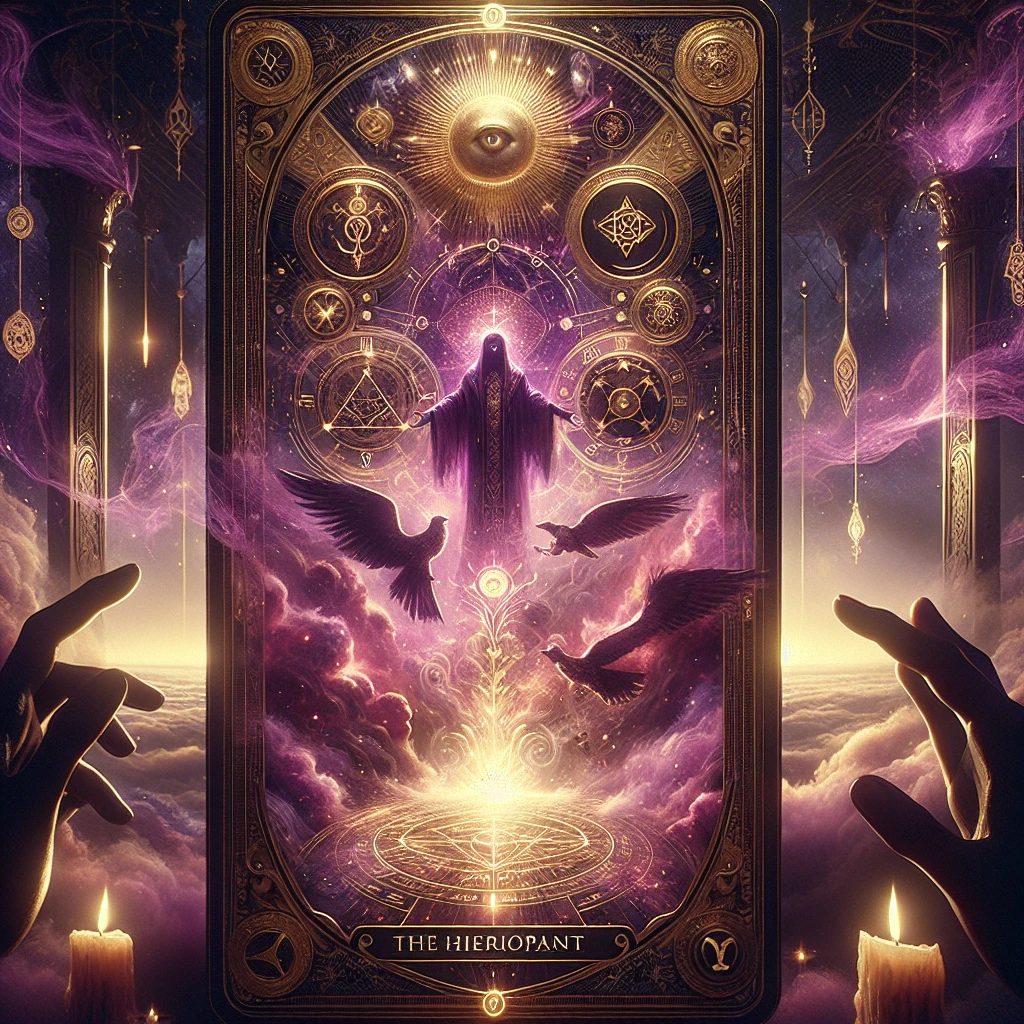
The Hierophant Tarot Meaning: Tradition, Mentorship, and Sacred Rule Breaking

The Hierophant Tarot Meaning: Tradition, Mentorship, and Sacred Rule Breaking

I’ve found that The Hierophant is one of the most polarizing cards in the deck. People see that stern figure in his formal robes and immediately think of rigid rules and suffocating dogma. It’s easy to write him off. But if you do, you miss the incredible guidance he offers on finding your people, learning from a master, and understanding the very architecture of a meaningful life. He isn’t just about following the rules; he's about showing you why the rules exist so you have a solid foundation to build—or break—from.

Meet The Hierophant: The Story Behind the Archetype

Picture yourself standing in a massive, ancient library, completely lost with a question that feels too big to solve. You're about to give up when a senior librarian walks over. They don't just point you to a dusty book; they sit with you, listen to your half-formed question, and then walk you to the perfect aisle, showing you how to find what you need for yourself next time. That librarian is The Hierophant. He’s the one who translates the big, overwhelming mysteries into a language you can actually use.

From temple to table: how this card shows up in real life

In my readings, I see The Hierophant—sometimes called the Pope or the High Priest—pop up as the structure that turns spiritual ideas into something you can practice. He might be your favorite college professor, the mentor who took you under their wing, or even the family recipes that make you feel connected to your past. He represents the formal path, the rite of passage, and the feeling of belonging to a group that says, "We get you. You're one of us."

Imagery decoded without jargon

When you look at the classic Rider-Waite-Smith deck, you’ll see The Hierophant sitting between two pillars, just like The High Priestess. But her pillars speak to intuition and mystery, while his represent the dependable structures of society—law and liberty.

  • The Blessing Hand: Notice his right hand, raised in a gesture of blessing. I read this as a green light, a sign of permission and protection. It tells you that the path you're considering is a recognized and supported one.
  • The Triple Cross: That staff in his left hand isn't just for show. It symbolizes his influence over three levels of being: your conscious mind, your subconscious depths, and your higher self. It’s a tool of complex spiritual authority.
  • The Crossed Keys: Look down at his feet. Those crossed keys represent access to hidden knowledge. You don't just stumble upon this wisdom; you earn the keys through study, discipline, and initiation.
  • The Acolytes: The two figures kneeling before him are crucial. They show you that knowledge isn't meant to be hoarded. It's a living thing that needs to be passed down, creating a chain of teaching and learning.

Taurus and the number five

Astrologically, I connect The Hierophant to Taurus, the grounded and stubborn bull. This connection is what keeps the card's high-minded spiritual lessons tethered to the real world. Taurus insists on practical application and tangible results.

Numerologically, he's the number five. Now, this is where it gets interesting. The number four (think The Emperor) is all about stability. Five is the number that crashes the party, bringing change and challenge. This gives The Hierophant a fascinating internal tension. He's a figure of tradition whose entire purpose is to help you navigate the very disruptions that life (the five) guarantees.

Alternate names and cultural lenses

Historically, you’ll see this card called the Pope, which ties it to organized religion. But you don't have to be religious for him to make sense. Today, I see him show up as any formal system of knowledge—a university, a trade union, a specific school of therapy, or a structured practice like a yoga teacher training. He guards the gates of tradition, whatever that tradition means to you.

Upright Hierophant Meaning: When Structure Protects Your Growth

When The Hierophant appears upright in a reading, it’s a clear sign to trust the path that others have walked before you. This isn't about blind obedience. It's about making a smart choice to learn from the experts. Getting the upright Hierophant tells me that you'll find the support you need for real growth by embracing tradition, finding a mentor, or signing up for that formal course of study. Established institutions and shared values are on your side right now.

Core narrative

The story here is about learning and belonging. You’re being invited to join a group, pursue higher education, or make a commitment official. When you align yourself with a proven system, you get the benefit of collective wisdom and a solid identity. This card is a nod toward conventional methods; following the "rules" right now will bring you security and success.

Love and relationships

In a love reading, I often see the upright Hierophant when a relationship is moving toward a traditional commitment. We could be talking about marriage, getting a place together, or simply defining the relationship along lines that your friends and family would recognize. It points to a partnership built on a solid, conventional foundation where you both share the same long-term goals and moral code. It’s a relationship that feels safe and respectable.

Career and money

Professionally, The Hierophant cheers you on for working within the system. This is a great card to see if you work for a large company, a hospital, a university, or the government. It says you'll succeed by being a team player, respecting the company culture, and learning from a senior mentor. Financially, this card advises you to stick to traditional strategies. Think savings accounts, blue-chip stocks, or getting sound advice from a certified financial advisor.

Health and spirituality

For your health, this card points toward conventional medicine. It’s time to listen to your doctor and stick with a tested treatment plan. Spiritually, The Hierophant invites you to go deeper by committing to a structured spiritual practice. This could be the perfect time to join a congregation, find a spiritual teacher, or commit to a daily ritual that grounds you.

Reversed Hierophant Meaning: Your Permission Slip to Question Everything

When you pull the reversed Hierophant, the world turns upside down. Those structures that once felt supportive now likely feel like a cage. This card is your official permission slip to challenge the status quo and blaze your own trail. It's a powerful call to examine the rules you live by and decide for yourself which ones still hold water. This is the energy of healthy nonconformity and building your own personal beliefs from the ground up.

Core narrative

The core story of the reversed Hierophant is liberation. You’re breaking free from needing everyone else's approval and learning to trust your own inner compass. I won't lie, this can feel shaky. You might find yourself questioning your upbringing, your family's beliefs, or society's expectations. But it’s a vital step toward living a life that is truly your own.

Love and relationships

In relationships, a reversed Hierophant can point to a desire for an unconventional partnership. You and your partner might be throwing out the old rulebook and designing a commitment that works for you, regardless of what anyone else thinks. It can also be a sign that you need to break away from a relationship that feels too restrictive or is built on someone else's expectations. It's about finding a love that celebrates your freedom.

Career and money

At work, you're probably feeling hemmed in by red tape and rigid thinking. The reversed Hierophant encourages you to innovate, challenge the old ways of doing things, or even strike out on your own as an entrepreneur. Financially, it's a caution against inflexible budgets and an invitation to explore alternative paths to income. Just be sure you're taking calculated risks, not just being reckless.

Health and spirituality

When it comes to your well-being, this card suggests you explore holistic or alternative therapies to complement conventional medicine. It’s time to listen to what your own body is telling you instead of just following a generic plan. Spiritually, this is a profound moment. You're graduating from organized religion or someone else's teachings to cultivate your own direct, personal connection to the universe, guided by the teacher within.

Feelings and Actions: What The Hierophant Signals About Motives and Next Steps

As an archetype, The Hierophant gives you sharp insights into the emotional tone of a situation and some very clear advice on your next move.

How they feel about you

When you ask how someone feels and The Hierophant shows up, it tells me they see you as a respectable, dependable, and "good" choice. Hierophant feelings are grounded in shared values and a genuine desire for a traditional commitment. This person admires your principles and can see a stable, honorable future with you. They want to do things the "right way."

What to do next

As an action card, The Hierophant's advice is almost always to seek guidance.

  • Find a Mentor: Go look for an expert in the field you want to enter. Don't guess.
  • Join a Group: Find a community, either online or in person, that shares your values.
  • Formalize Your Knowledge: It's time to sign up for that class, workshop, or degree.
  • Honor Tradition: Take part in a family or cultural ritual. It will connect you to your roots.

Reversed emotional climate

Reversed, the feelings are much messier. The person might feel suffocated by expectations or be actively fighting against them. I often see this when someone is questioning their own beliefs about what a relationship "should" be. They might feel you're too conventional for them, or they could be wrestling with their own desire to break free from a traditional mindset.

Yes or No and Timing: The Hierophant’s Green Lights and Caution Signs

The Hierophant rarely gives a simple yes or no. He brings a sense of deliberation to the table, asking you to look at the bigger picture.

Yes or no with nuance

Does this card mean yes or no? I'd call The Hierophant a "Yes" if your question is about:

  • Following a well-defined plan.
  • Making a formal commitment, like a marriage or business contract.
  • Joining an organization or school.
  • Getting the stamp of approval from an authority figure.

I read it as a "No" or at least a "Not yet" if your plan is to break all the rules and go it alone. He suggests you need to build a solid foundation first before you can successfully tear down the walls.

Timing with Taurus season

Because it's a Major Arcana card, The Hierophant usually points to a significant life chapter rather than a specific date. But its link to Taurus can be a hint. You might see things start moving during Taurus season (roughly April 20 to May 20). The card also suggests things will happen on a formal schedule, like an academic semester or a court process. Expect a deliberate, steady pace, not a sudden breakthrough.

Situational checkpoints

To get clear on the Hierophant's message, ask yourself these questions:

  • Is this path actually aligned with my deepest values?
  • Am I getting advice from someone I genuinely trust and respect?
  • Does this choice connect me to a community or tradition that feels like home?
  • Where do I need more tradition vs. innovation in my life right now?

Card Combinations: How The Hierophant Changes the Conversation

The Hierophant’s meaning can shift dramatically depending on the cards you pull with it. He often acts as an anchor, bringing a theme of structure—or rebellion—to the whole reading.

With The Lovers or The High Priestess

  • The Hierophant + The Lovers: When I see these two together, I almost always know we're talking about marriage or a sacred, public commitment. It takes the personal choice of The Lovers and elevates it into a formal union built on shared beliefs.
  • The Hierophant + The High Priestess: This is a fantastic pairing. It shows you're bridging the gap between external teachings (Hierophant) and your own deep intuition (High Priestess). You're not just following rules; you're integrating them into a belief system that is authentically yours.

With The Devil or The Magician

  • The Hierophant + The Devil: This combination can be a major red flag. It often points to a controlling religious group, a toxic work culture, or blind conformity. It forces you to ask if a belief system is empowering you or enslaving you.
  • The Hierophant + The Magician: I love seeing this. It tells me the student has become the master. You've taken all that theory and book-learning (Hierophant) and are now using it to create real, tangible results in the world (Magician).

With Pentacles and Swords

  • With Pentacles: Paired with the suit of Pentacles, The Hierophant often directs your attention to financial or corporate structures. With the Four of Pentacles, for instance, it could suggest a very conservative approach to saving money through an old-school bank.
  • With Swords: Combined with Swords, the focus shifts to ideas, laws, and dogma. If you pull it with the Justice card, you might be looking at a legal proceeding or a situation that requires you to follow a strict moral code.

A mini spread that tells a coherent story

Let's say you pull these three cards: Page of Swords - The Hierophant - The Sun

I would read this as the story of a curious, truth-seeking student (Page of Swords) who decides to enroll in a formal program of study (The Hierophant). Through that structured path, they find incredible success, clarity, and pure joy (The Sun).

Reader’s Toolkit: Troubleshooting Confusion and Context

The Hierophant can be a tough card, especially if you're new to tarot or have complicated feelings about organized religion.

If marriage or religion are not relevant

Think bigger. Don't get stuck on the literal Pope image. I tell my clients to think of institutions as any shared system of belief. This could be:

  • The culture at your office.
  • A specific therapeutic model, like CBT.
  • A 12-step recovery program.
  • A particular school of yoga.
  • The unwritten rules of your own family.

The Hierophant is less about a specific faith and more about our human need for mentorship, community, and a shared code of conduct.

Decision tree for structure vs freedom

When The Hierophant shows up, walk yourself through this process:

  1. Is my main goal right now to learn something new, gain credibility, or find my tribe?
    • If yes, the upright Hierophant is telling you to lean into structure. Find the teacher. Take the course. Follow the program.
  2. Is there a system in my life that makes me feel trapped, fake, or small?
    • If yes, the reversed Hierophant is giving you a green light to question it, challenge it, and find a different way that honors who you really are.

Avoiding dogma in readings

When I'm reading for someone, my goal is to empower them, not to preach at them. The Hierophant is a mirror for your relationship with structure, not a command from on high. I use phrases like:

  • "It looks like you might get some real traction from a more structured approach..."
  • "Where in your life do you feel that tension between tradition and your own truth?"
  • "What would it feel like to find a mentor who actually respects your unique way of doing things?"

Your job as a reader is to use the card to open up a conversation, not to lay down the law. True guidance gives people options; dogma takes them away.

Rituals and Practices: Ground The Hierophant in Daily Life

Don't just leave The Hierophant's wisdom on the table. Here’s how you can bring it into your everyday life.

Journal prompts that reveal your core values

Use these journal prompts to have a chat with your inner guide:

  • Who are the teachers I trust most in my life, and what are the most valuable things they've taught me?
  • What traditions—family, cultural, or even personal ones I've created—give my life shape and meaning?
  • What is one "rule" I follow without thinking? What's one I'm ready to break on purpose?
  • Write down your personal mission statement or code of ethics. What are 5 principles you refuse to compromise on?

Create a learning or mentorship plan

Pick one area of your life where you feel stuck or want to grow.

  1. Identify a Goal: Get specific. "I want to learn the basics of investing" or "I want to start a consistent meditation practice."
  2. Find a Source: Do some research. Find a reputable online course, a respected book on the subject, or a person you admire who might act as a mentor.
  3. Make a Commitment: Draft a simple mentor plan. You could dedicate one hour every Saturday morning to your studies, or schedule a coffee meeting with that person you admire. The Hierophant rewards consistent, structured effort.

A simple ceremony for commitment

You don't need a cathedral to make a sacred vow. You can create a potent personal ritual right at your kitchen table.

  • Define Your Vow: On a nice piece of paper, write down a single, clear promise to yourself. (e.g., "I commit to honoring my body with good food," or "I commit to my creative work.")
  • Create a Sacred Space: Light a candle. Hold something that feels solid and real, like a favorite stone or a family heirloom.
  • Speak It Aloud: Read your vow out loud. Hearing your own voice say the words gives them power.
  • Mark the Moment: Put that piece of paper somewhere you'll see it every single day—on your mirror, your desk, or your fridge. This simple act solidifies your intention.

Symbolism in Motion: Keys, Cross, Blessing, and Acolytes

The symbols on this card aren't just pretty pictures; they describe an active process of passing on wisdom.

Keys as access and responsibility

When I see those crossed keys, I think about earned access. You don't just get handed the keys to the kingdom. You get them after you've done the work, studied the material, and proven you're ready. This could be your diploma, your professional certification, or your initiation into a group. But with access comes the responsibility to use what you know with integrity.

Blessing hand as permission and protection

That hand raised in benediction is a powerful symbol. It's a spiritual green light that says, "You're on the right track. You are safe here. You have our blessing to move forward." In a reading, it can be a huge comfort, assuring you that by following a structured path, you're not alone.

Triple cross and layered authority

The triple cross reminds me that the institutions The Hierophant represents are complex. Their authority isn't just about surface-level rules; it operates on physical, mental, and spiritual levels. Part of your work is to understand this complex structure, not just follow it blindly.

Acolytes and the cycle of learning

Those two kneeling acolytes are so important. They show us that wisdom is meant to be shared. You're always in a cycle of learning and teaching. Sometimes you're the student, humbly taking it all in. Other times, you're the teacher, generously passing on what you know. This card always makes me ask my clients: which role are you playing right now?

Personas and Perspectives: Student, Mentor, Rebel

The Hierophant can show up in a reading as you, someone else, or the general situation. Figuring out which part you're playing is key to understanding the card's message.

When you are the student

If you're the student in this scenario, your only job is to be humble, listen, and learn. Acknowledge that you don't have all the answers yet. Your superpower right now is your willingness to apprentice yourself to a person or a practice that has proven its worth over time.

When you are the mentor

If you find yourself in the role of the mentor, your duty is to share what you know with integrity. It's on you to uphold the standards of your craft while also making room for your students to find their own way. A true Hierophant guide creates a safe space for others to learn, they don't just dictate the rules.

When you are the rebel at the gate

If you feel like the rebel, your task is to question things with a clear purpose. You're not breaking rules just for fun; you're doing it because your core values are demanding a new approach. The challenge is to forge your own path while still respecting what's valuable about the tradition you're leaving behind. A constructive rebel wants to build something better, not just burn the old thing down.

FAQ

What does the Hierophant mean in tarot?

The Hierophant represents tradition, formal education, spiritual guidance, and shared belief systems. I see him as the archetype of the teacher or mentor who provides a structured path to knowledge. He often points to things like universities, churches, established communities, and traditional commitments like marriage.

What is the message of the Hierophant?

His main message is to seek out trusted guidance and honor the wisdom that has come before you. He suggests you'll benefit from learning within an established system, finding a mentor, or joining a community that shares your values. It's about finding security and meaning by connecting to something larger than yourself.

Is the Hierophant a positive card?

Yes, I generally read The Hierophant as a positive card. Upright, it signals stability, belonging, wise counsel, and the comfort that comes from a proven path. It suggests that if you follow a conventional route right now, you'll likely find success. Reversed, it can point to a difficult but necessary period of breaking free from old rules that no longer fit.

What is the Hierophant advice in Tarot?

The Hierophant's advice is clear: don't try to reinvent the wheel right now. Seek out an expert. Sign up for the class, find the mentor, join the club, study the tradition. He advises you to choose the conventional, reputable, and time-tested option over the risky, unproven one.

Start your reading