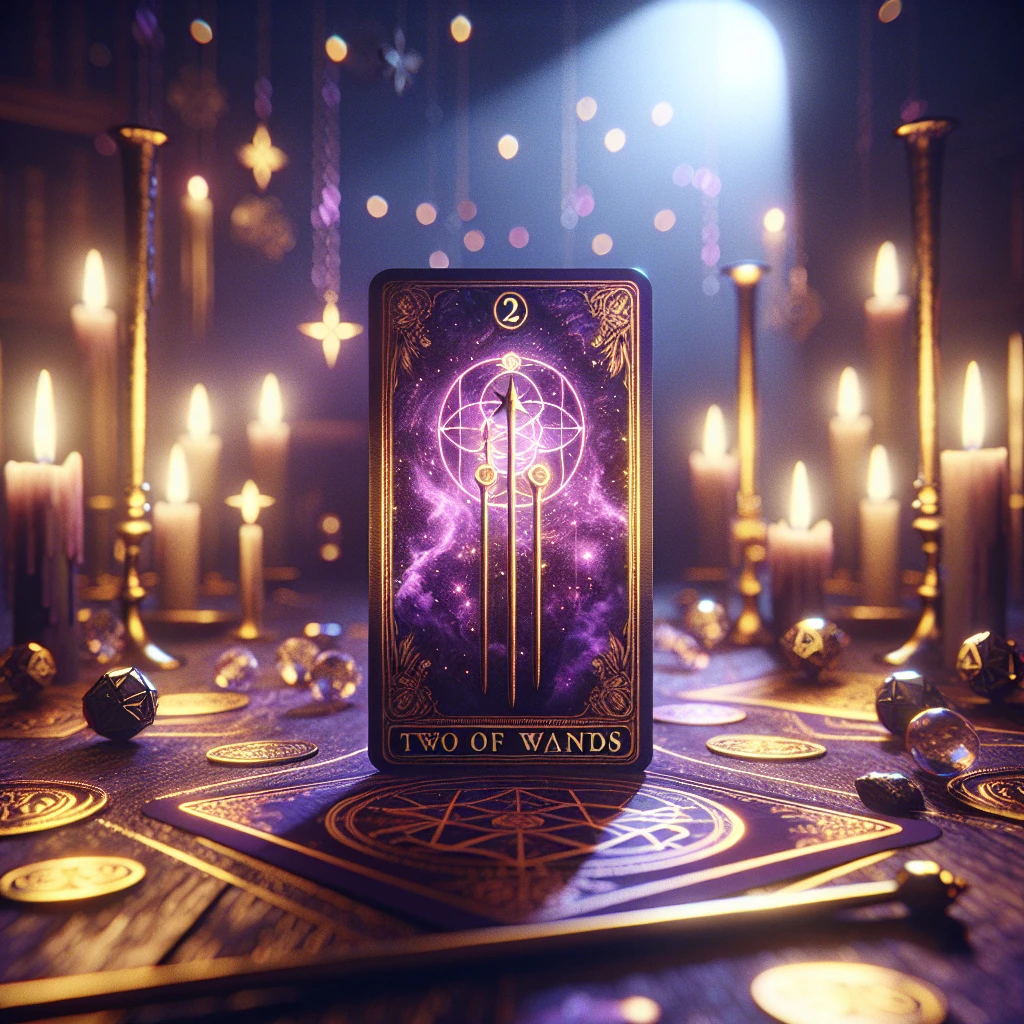
The man on the Two of Wands holds the whole world in his right hand and is still standing on his own roof. That gap between the size of the plan and the safety of where you stand is the whole card. It describes the moment after you know what you want and before you have left home to get it: you are weighing the map, measuring your resources, and deciding how far you are willing to go.
Upright, the Two of Wands means planning with ambition, a wider view, and a choice between staying in the known and reaching for something bigger. Reversed, it shows fear of leaving familiar ground, a plan cut down to fit your comfort, or a decision made by default because no decision was made at all. As a yes or no card, it gives a yes to people who are prepared to plan, while for anyone hoping things will sort themselves out, the answer is closer to not yet.
The table: what changes when the card turns
| Area | Upright | Reversed |
|---|---|---|
| General | A clear plan, a bigger horizon, a decision about direction | Staying put out of fear, thinking small, drifting into a choice |
| Love | Planning a shared future, talking about where to live and how | One partner has a plan the other is not part of, or neither will name what they want |
| Career | Mapping the next step, preparing to expand or change roles | Holding back from an application or proposal, settling for the safe option |
| Money | Budgeting for a goal, saving with a purpose | Money kept idle out of worry, or a budget that leaves no room for the goal |
| Health | Setting a realistic routine and sticking to a start date | Endless preparation for a change that never begins |
| Advice | Write the plan down and set the first date | Ask what you would choose if the familiar option did not exist |
The health row is about routines and willpower, not about diagnosis; a tarot card cannot replace what a doctor learns from an examination.
Where the Two of Wands sits in the Golden Dawn system
Wands are the suit of Fire, and the Golden Dawn gave the Two of Wands the title Lord of Dominion with the decan of Mars in Aries, the first ten degrees of the sign. Crowley's Thoth deck keeps the short title "Dominion". In practical terms, that pairing describes drive that already has a direction: the energy is real, and the question is where to aim it.
Twos belong to Chokmah, the second Sephira on the Tree of Life, where a single impulse first becomes a direction. In the run of the Wands from Ace to Ten, the Two follows the raw spark of the Ace and comes before the Three, where ships are already sailing. It is the planning stage of the suit: the idea exists, the resources are counted, and the departure is still ahead.
On Marseille cards the Two of Wands is simply two crossed batons with leaves and flowers around them. Everything else arrived with Pamela Colman Smith's 1909 drawing: the man on the battlements, the globe in his right hand and a wand in his left, a second wand fixed to the wall, a rose and a lily crossed on the stonework, and a bay with a village and mountains below. The rose and lily together suggest desire balanced with clear intention, and the fixed wand is what he is leaving behind if he goes.
Three checks for a reversed Two of Wands
- Is the plan too small? If you have shaped the goal around what feels comfortable rather than what you want, the reversed card points at the shrinking. A family that needs a third bedroom keeps looking only at flats in the same street because the school run is easy; the reading asks whether the street is the real requirement.
- Is fear doing the choosing? If every option you consider keeps you exactly where you are, the reversal describes fear of leaving the known. Notice which reasons are practical and which are simply unfamiliarity.
- Has the decision already been made by default? Sometimes the reversed Two shows that the window passed while you were weighing it. Then the question becomes what plan to make next, not how to undo the last one.
If none of these fit, look at the card right after it. A Wands card there usually shows the plan resuming; a Pentacles card often shows a practical limit that needs solving first.
Cards that steer the Two of Wands, and the one it is mistaken for
The card most often confused with it is the Three of Wands. Both show a figure looking out over water, but the Two is still on the roof with the globe in hand, deciding, while the figure on the Three has already sent ships out and is watching for their return. If you are still choosing, it is the Two; if you have acted and are waiting for results, it is the Three.
- Two of Wands + Four of Wands: a plan centred on home. A couple sketching an extension on graph paper at the kitchen table finally books a builder for a quote.
- Two of Wands + Ace of Pentacles: a plan that has its funding. Savings reach the number you set, and the project can start.
- Two of Wands + Eight of Cups: leaving something emotionally finished for a direction chosen on purpose. A woman who has spent years organising her family's every holiday tells her siblings she will plan her own trip this year.
- Two of Wands + Two of Swords: a decision stalled between two good options. Two parents keep postponing the choice between two schools because neither wants to admit which one they prefer.
- Two of Wands + The World: a plan with real reach, often involving family in other countries. Grandparents start planning a long stay with their daughter's family on another continent.
- Two of Wands reversed + Four of Pentacles: a home where security has become the only value, so no plan ever gets past the first conversation.
Love under the Two of Wands
In relationship readings, this card often shows a couple at the stage of deciding what their shared life will look like: which city, which kind of home, whether to have children, how to divide time between two families. It favours conversations where both people put their real plans on the table instead of hinting.
For someone who is single, the Two of Wands suggests a period of choosing rather than waiting. You may be weighing a relationship close to home against one that would require more change, or deciding what you want before you go looking. The card supports widening your circle, but with an idea of what you are actually looking for.
Upright, it can describe a partner with ambition and a long view, someone who thinks in years. Reversed, it shows a mismatch in reach: one person keeps planning a life elsewhere while the other has quietly settled, or both avoid the conversation because the answer might be uncomfortable.
Work and savings planned from a home base
The Two of Wands is a strong card for anyone working out their next professional move from a stable position. A parent coming back after a year of leave sits down with a calendar and a childcare price list and works out whether to return full-time, ask for four days, or use the break to change field. The card describes exactly that kind of planning: a base that is secure, and a choice about how far to reach from it.
It also suits people building something on the side: a home workshop, a small online shop run from the spare room, a skill being turned into paid work in the evenings. The advice is to plan in concrete steps with dates, because the Two's main weakness is staying on the roof too long.
For money, the card favours saving with a named purpose. An adult son living with his parents for two years to save toward his own place fits the upright card well, as long as there is a target figure and a deadline. Reversed, the same arrangement turns into comfort that quietly extends year after year.
FAQ
Why does the man on the Two of Wands hold a globe?
The globe shows the size of what he is considering: the world, or at least more of it than he can see from where he stands. Holding it in his hand suggests that the plan still lives in his head. Once he moves, the card becomes the Three of Wands.
Why is the Two of Wands called Dominion in the Thoth deck?
Crowley followed the Golden Dawn title Lord of Dominion. Dominion here means control over your own direction rather than power over others: Mars in Aries gives force, and the Two gives it a single aim. The Thoth image shows two crossed dorjes with flames, a more abstract version of the same idea.
What does the Two of Wands mean for a parent whose children are about to leave home?
It points to the question of what comes next for you, not only for them. The globe in the man's hand fits a parent who suddenly has evenings, space and attention to spend, and the card encourages making a real plan for that time: a course, a change of hours, a long-postponed trip. Reversed, it can show a parent holding on to the old routine, or children delaying their own plans so as not to leave someone alone.
Does the Two of Wands reversed mean I should stay where I am?
Not automatically. It means you should check why you are staying. If staying is a choice you have made with open eyes, the reversed card may simply describe the end of a fantasy you no longer need. If you are staying because the alternative feels frightening, the card asks you to separate fear from fact.
What if the Two of Wands describes my partner's plans rather than mine?
Then the reading is about a plan you need to hear in full. The card shows someone looking out at a horizon you may not have discussed yet. Ask what they are planning and where you fit in it, and look at the next card: a Cups card suggests the plan includes you, while Swords suggest a conversation that has been put off.