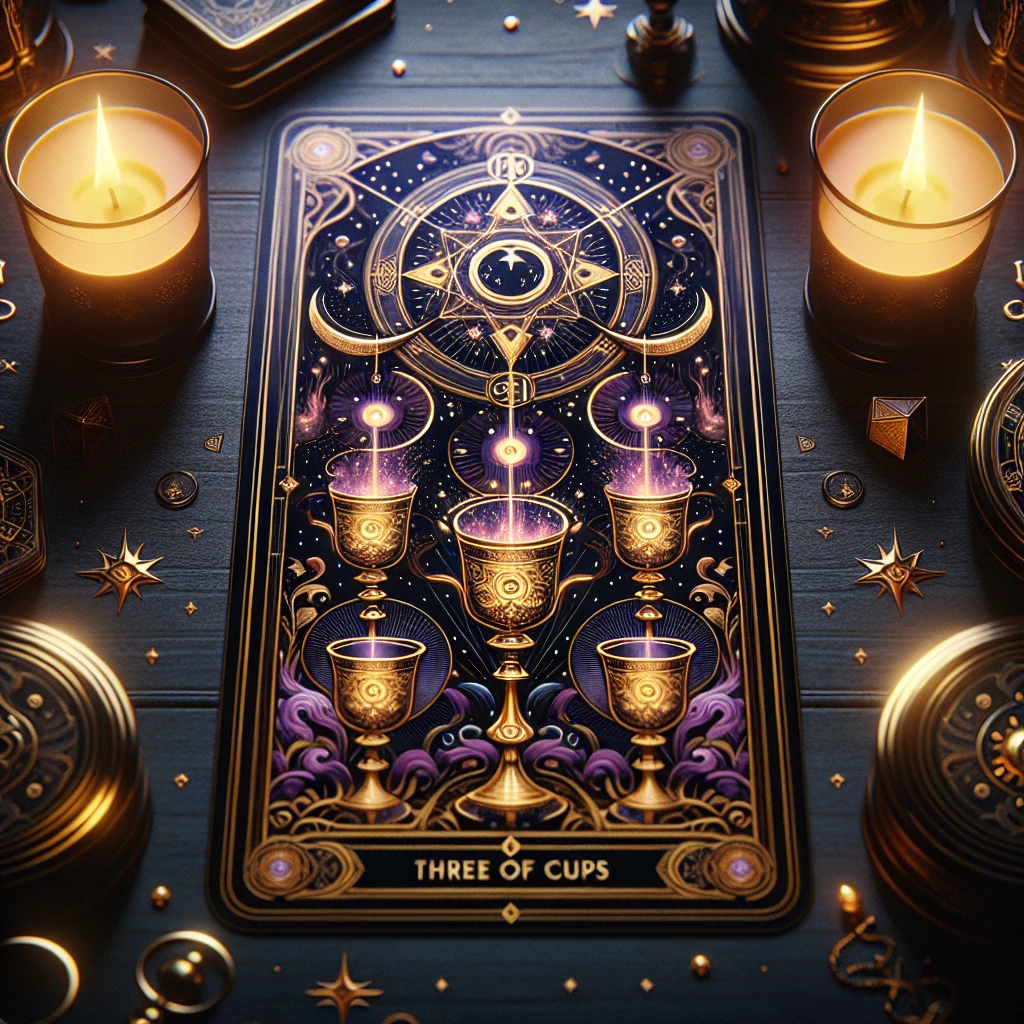
Three cups arranged in a triangle, with a flowering vine curling between them: that is all a Marseille deck gives you for this number. The dancing women most readers now associate with the card arrived only in 1909, and the way the image changed explains a good deal about how the card is read today.
Where the three dancing women came from
| Deck | How the Three of Cups looks |
|---|---|
| Tarot de Marseille | A pip card only: three cups among stylised leaves and flowers, no people |
| Sola Busca (1491) | Illustrated pips, but no direct ancestor for this card |
| Rider-Waite-Smith (1909) | Three women in a circle raising their cups, with fruit and a pumpkin at their feet, a composition with no older model |
| Thoth (Crowley and Harris) | Titled "Abundance": three pomegranate cups filled from lotuses |
For most of tarot's history, the numbered cards were decorative. A reader working with a Marseille deck read the Three of Cups from its number and suit: three, the first number that makes a group, and cups, the suit of feeling. There was no scene to interpret, only a count and a mood.
Pamela Colman Smith changed that when she designed the card for the 1909 deck. Her three women, garlanded, lift their cups together in what looks like a harvest garden. Some readers compare them with the Three Graces of classical art, though she left no note about her source. Whatever inspired it, the image fixed the card's modern meaning: people who are glad to be in each other's company, celebrating something they share.
Three of Cups meaning at a glance
The Three of Cups describes friendship, shared joy and the support of a group. It covers celebrations, reunions, good news told to people who care, and the plain pleasure of belonging somewhere. Reversed, the same circle can turn draining: gossip, too much partying, a clique, or a third person entering a couple.
- Upright: friendship, celebration, community, support, a reunion, teamwork that feels light
- Reversed: gossip, a group that drains you, overindulgence, exclusion, a third person in a relationship
- Suit & number: Three of Cups, Minor Arcana
- Element & decan: Water; Mercury in Cancer (20°–30°), which suits a card about talk, news and home
- Tree of Life: Threes belong to Binah, where a single impulse first takes shape
- Yes/No: yes, especially when other people are involved
When the toast is genuine: the upright Three of Cups
Upright, the card is about joy that multiplies when it is shared. Think of three cousins who split the cooking for their grandmother's eightieth birthday: one makes the soup, one bakes, one brings the folding chairs from a neighbour, and nobody keeps count of who did more. The meal matters, but what the card points to is the way the work turns into part of the celebration.
The Three of Cups often marks a moment worth gathering for, such as a recovery, an anniversary, a new home or an exam passed by a teenager who struggled all year. It also describes ordinary support that is easy to overlook: the neighbour who takes in your parcels, the friend who calls when she knows you have had a rough week, the group of parents who swap school runs so that everyone gets one free morning.
As advice, the card says to let people in. If you have been handling something alone, it suggests telling the friends who would want to know, both the good news and the difficult kind.
How the Three of Cups changes when reversed
Reversed, the circle still exists, but something in it has gone sour. Gossip is the most common form. At family visits one relative opens every conversation with news about whoever is absent, and soon everyone wonders what is said about them once they leave. Being part of that circle starts to cost more energy than it gives.
Overindulgence is another form: a run of parties, takeaways and late nights that felt like fun and now feels like a habit. The card can also show exclusion, when you are the one left outside the circle, or when a group of old friends has become a clique that no longer has space for anyone new.
In relationship questions, the reversed Three can point to a third person, whether that is an affair, a close friend who interferes, or a parent who has too much say in a couple's decisions. Context decides which one applies, and the cards around it usually make the difference clear.
Three of Cups or Four of Wands?
Both cards show people celebrating, and both appear around weddings, parties and homecomings, so they are often mixed up. The difference lies in what is being celebrated. The Four of Wands marks a milestone: a house is finished, a stage of life is complete, and the community gathers to recognise it. The Three of Cups celebrates the bond itself. The occasion may be small or there may be none at all; what counts is the people.
In practice, a housewarming party reads as the Four of Wands when the point is the new flat, and as the Three of Cups when the point is that your friends turned up, helped you carry boxes and stayed until two in the morning. If both cards appear together, you have the milestone and the people to share it with.
Is the Three of Cups a good sign for love?
In love, the Three of Cups puts a relationship in the context of friends and family. For someone looking for a partner, it often shows a meeting through a social circle: the friend of a friend at a birthday, or a neighbour you got to know while organising a courtyard clean-up. It favours relationships that start easily and without pressure, with a lot of laughter early on.
In an existing couple, the card shows a relationship that fits into a wider life. Your partner gets on with your friends, the families meet and like each other, and celebrations become shared. It can also mark a happy event inside the couple, such as an engagement party or a holiday with the people you love most.
Reversed, look at the third element in the circle. Sometimes it is a real rival. More often it is friends who take sides after a quarrel, a parent who comments on everything, or a partner who prefers nights out with the group to time alone with you. The question to ask is who else has a seat at your table and whether you invited them.
The Three of Cups in teamwork and shared money
Teamwork that actually works is what this card describes in a career reading. A small group of colleagues who like each other finishes a project with energy left over, and celebrates at the end. It also suits creative collaborations, community projects, events, hospitality, and any work where relationships matter as much as results.
For money, the Three of Cups points to shared resources and good news. It can show a group purchase, money pooled for a gift or a family celebration, or a bonus that arrives just in time for a holiday. It is not a card about saving; it favours spending on people.
Reversed, it warns of office gossip, a team split into camps, or spending more on going out than you planned. If you work with friends or relatives, it can show a moment where the friendship and the business are pulling in different directions.
What answer does the Three of Cups give?
Yes, as a rule, and most confidently for questions about events, reunions, friendships, invitations and anything that depends on other people's goodwill. Will the family come together for the holiday? Will the neighbours support the idea? The card says they are likely to.
The decan of Mercury in Cancer covers roughly 12 to 22 July, which a few readers treat as a literal window. More practically, the card links its answer to an occasion: a birthday, a holiday or a gathering already on the calendar. Reversed, the answer becomes "yes, but watch who is involved", or a delay caused by other people's moods and schedules.
FAQ
Does the Three of Cups mean a love triangle?
Upright, very rarely; it is a card of friendship and shared joy. Reversed, it can point to a third person in a couple, but that person is not always a romantic rival. A best friend, an ex who is still around or an intrusive relative can all fill the third place on the card.
What does the Three of Cups say about siblings?
It is one of the best cards for brothers and sisters. It shows siblings who enjoy each other as adults, help each other without keeping score and come together for family events. Reversed, it can describe two siblings sharing a complaint about the third, or old roles from childhood returning at every gathering.
Is the Three of Cups a warning about drinking too much?
Reversed, it can be, since overindulgence is one of its traditional meanings. Upright, it simply describes celebration. Cards reflect mood and habits rather than the state of your body, so if your drinking worries you, a doctor is a far better guide than any spread.
What does the Three of Cups mean with the Five of Cups?
The Five of Cups shows grief or regret. Together, the two cards describe sadness shared with others: friends who come round after a loss, a family who gathers to remember someone, or support arriving when it is most needed. The pairing suggests you do not have to carry the loss on your own.
Does the Three of Cups promise new friends in a new neighbourhood?
It points strongly in that direction. If you have recently moved and draw this card, it suggests that the people next door, at the playground or in the local shop are more open than they seem. Accept the first invitation, even a small one; the card shows a circle that forms through small, repeated contact.