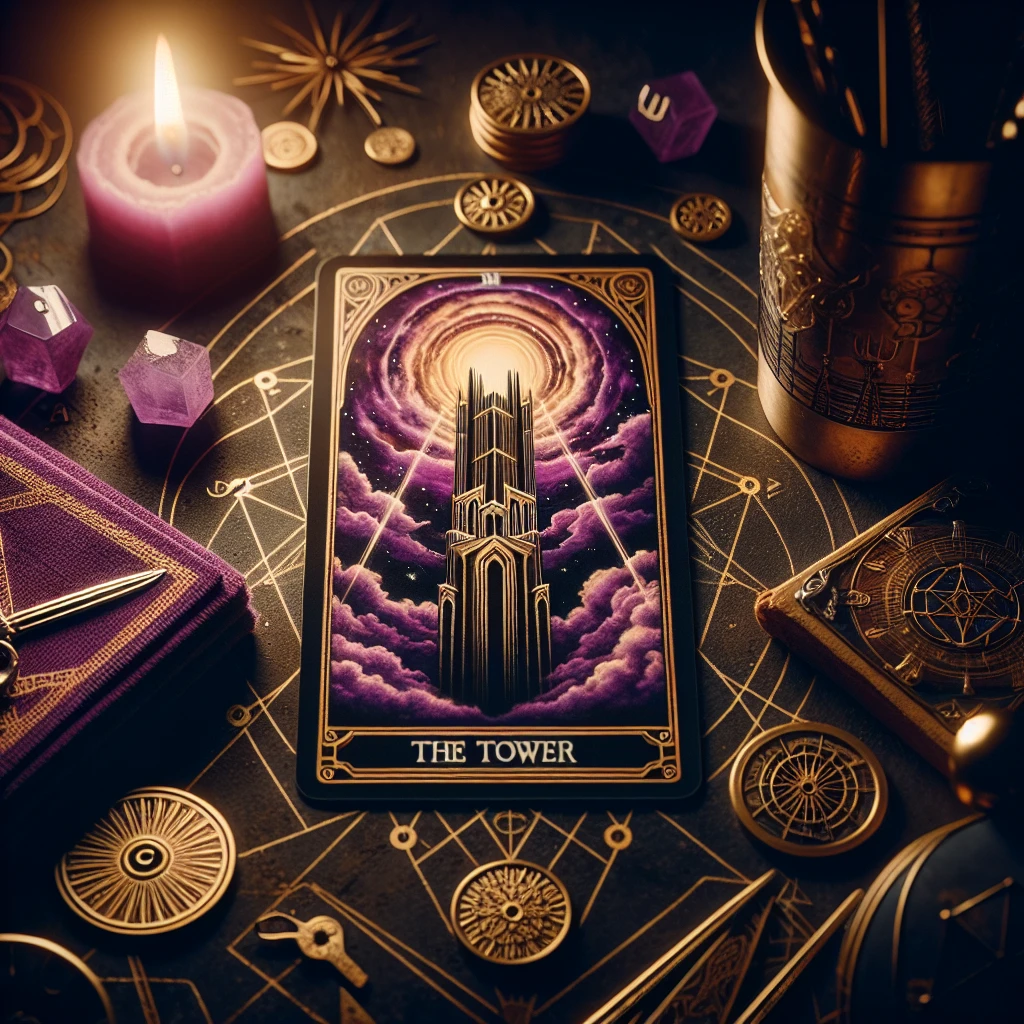
The Tower is card XVI of the Major Arcana and stands for sudden, unavoidable change that brings down whatever was built on a weak or false foundation. Upright, it means a shock, a revelation or a collapse that ends an illusion and clears the ground for something more real. It hurts, but what falls was already failing.
- Upright: sudden change, upheaval, revelation, collapse of false structures, shock, release
- Reversed: resisting change, averted disaster, delayed collapse, inner upheaval, fear of change
- Number/Arcana: XVI, Major Arcana
- Element/planet: Fire, Mars
- Yes/No: No (explained in the yes/no section below)
What do the symbols on The Tower card mean?
The Rider-Waite-Smith card, drawn by Pamela Colman Smith for A. E. Waite in 1909, puts the whole meaning into one scene; Waite called it the ruin of a "House of Falsehood". The older Tarot de Marseille names the card La Maison Dieu, "the House of God". The Golden Dawn assigned it to Mars, which is why it is read as a Fire card of force and sudden action.
- The tower. A tall stone building stands for anything built up over years and assumed to be permanent: status, a routine, a shared life, a fixed idea of who you are.
- The lightning. A bolt from the sky hits the top of the tower. It is an outside event or a flash of insight that you did not choose and cannot stop.
- The crown. The lightning knocks a gold crown off the roof. It stands for control and the belief that you are in charge, and it goes first.
- The falling figures. Two people fall headfirst, one crowned and one not. Rank offers no protection, and the fall turns your usual way of thinking upside down.
- The 22 flames. Flame-shaped drops, read as the Hebrew letter yod, fall ten on one side and twelve on the other. They are linked to the ten sephiroth of the Tree of Life and the twelve zodiac signs, and their total matches the 22 Major Arcana.
- The grey clouds. Heavy clouds fill a dark sky: the confusion of not seeing past the event while it lasts.
- The rock. The tower stands alone on a bare, jagged peak. It was built on ground that could never support it, so the fall is a correction, not random bad luck.
What does The Tower mean upright?
Upright, The Tower describes an event that arrives fast and changes the situation for good. Picture a meeting called for 9:00 with no agenda, or a message from someone you had stopped expecting to hear from. Within an hour, something you treated as fixed is gone.
The key idea is that what falls was weaker than it looked. A small business living on one large contract, a marriage where every hard topic was postponed until "after the holidays", a plan that counted on a promotion nobody had confirmed: these are the structures The Tower tends to expose.
Shock and anger are normal reactions. What the card does say is that the old arrangement cannot be put back together, so energy spent rebuilding the same walls is mostly wasted.
In the Major Arcana, The Tower comes right after The Devil (XV), the card of attachment and self-imposed limits, and right before The Star (XVII), the card of recovery and hope. In sequence they tell a short story: the trap breaks, then relief arrives.
What does The Tower mean reversed?
The reversed Tower has three main readings; the question and nearby cards show which applies.
- Resisting change. You can see the cracks but keep patching them. The collapse is delayed, not cancelled, and every month of delay raises the cost, as when you renew a lease on a flat you already know you have to leave.
- Averting disaster. The warning came early enough. You read the small print before signing, or call the doctor about the thing you were going to ignore, and the damage stays small.
- Inner upheaval. The structure that falls is internal: a belief, an identity, a long-held story about yourself. Outwardly little changes, but your view of yourself shifts, more like a quiet personal crisis than a dramatic event.
When the reading points to resistance, the advice is to make the change on your own terms before circumstances make it for you.
What does The Tower mean in love and relationships?
In a relationship. The Tower points to a crisis that tests the foundation. Sometimes it is a revelation or a serious fight; sometimes it comes from outside, like a landlord's letter saying the flat is being sold, which suddenly forces two people to decide whether they are building a future together. Some couples part here; others come through because the crisis forces an overdue honest conversation. The card shows the shake-up, not the final result, so look at the cards that follow it.
If you are single. It often marks the end of an illusion about love: an idealised ex, a habit of choosing the same kind of partner, or a belief about what you deserve. It is more about clearing old expectations than about new romance.
As feelings. The Tower describes strong, unsettled emotion: shock, confusion, sudden attraction, or the sense that their life has turned upside down. Intense, but not stable.
As intentions. As someone's intentions, it suggests abrupt action rather than a plan: a sudden confession, ending things without warning, or a dramatic decision made in the moment. It is not a clear commitment.
Reversed in love, the card often shows a couple avoiding a necessary conversation or a breakup that keeps being postponed.
What does The Tower mean for career and money?
At work, The Tower can show a reorganisation announced at an all-hands meeting, a layoff, a cancelled project or new management that changes the rules overnight. It can also be self-initiated: you hand in your notice after one bad week that made months of doubt impossible to ignore.
With money, it points to unexpected expenses, losses, or the failure of something you relied on, such as the client who pays half your income moving to a competitor. It is a clear argument for an emergency fund. If you are weighing a risky financial move, The Tower advises waiting.
What does The Tower mean for health and wellbeing?
In wellbeing questions, The Tower usually reflects stress: strain felt in body and mind at once, poor sleep, burnout, or a crash after holding everything together for too long. Tarot is not a medical forecast, so if you have symptoms or health concerns, see a doctor or another qualified professional.
Is The Tower a yes or no card, and what does it say about timing?
As a yes/no answer, The Tower is a No. Instability is a poor sign for a plan, a purchase or a reconciliation going smoothly. The exception is a question about change itself, such as "Is this situation about to change?" or "Will the truth come out?" There the card leans toward yes, though rarely in a comfortable way.
For timing, The Tower means suddenly and with little warning. Events are likely to move faster than you expect and may arrive all at once, which fits its link to Mars. Reversed, it points to delay: the change is coming more slowly or is being held off.
Which card combinations change The Tower's meaning?
- The Devil before The Tower: a dependency or controlling situation finally breaks open, usually through an event you would not have chosen. Think of a debt that can no longer be hidden, or the job you stayed in only for the salary closing its office.
- The Tower followed by The Star: the most hopeful sequence for this card, where disruption gives way to recovery. A layoff that leads, a few months later, to work that actually suits you fits this pair well.
- The Tower with Death: a phase ends, and it ends abruptly rather than gradually. A sudden breakup followed by a move to another city is a typical picture.
- The Tower with Ten of Swords: a painful, final ending where the situation has hit bottom. A deal that collapses after months of negotiation, with no way to revive it, matches this combination, and the only direction left is up.
- The Tower with The Sun: the shock brings clarity and, soon after, relief. A conflict that everyone avoided finally comes out in one tense meeting, and afterwards the air is clearer than it has been for years.
- The Tower with Ace of Pentacles: a material reset in which a loss makes room for something steadier. Losing a contract or a job is followed by a more stable offer within weeks.
What should you do when you draw The Tower?
- Draw one clarifying card. Ask "What exactly is falling?" and place one card next to The Tower. Pentacles point to money or work, Cups to relationships, Swords to a belief or a conflict, Wands to a project or plans.
- Check the card that follows. In a spread, the next position shows where this leads. In a one-card reading, draw one more for "What comes after this?" The Star, The Sun or an Ace suggest recovery; heavy Swords cards suggest a harder stretch that needs patience.
- Secure the basics, then ask again later. First cover what is urgent: rent, the next few weeks of money, people you can call. Do not redraw the same question the same day hoping for a softer answer; return to it in two or three weeks, once things have settled.
FAQ
Is The Tower a bad card?
It is one of the hardest cards in the deck, but "bad" is too simple. What it removes was already unstable or untrue, so the long-term result is often better than the situation before it.
What does The Tower mean in the past, present or future position?
In the past position, it points to an upheaval you are still recovering from. In the present, the change is happening now or has just begun. In the future position, it warns of disruption ahead, which gives you time to find what is fragile and strengthen it.
Does The Tower always mean a breakup?
No. In love readings it shows a crisis or a revelation, and a breakup is one possible outcome, not the only one. The Star or The Sun after The Tower point to recovery, while Ten of Swords suggests a definite ending.
Can The Tower be positive?
Yes, especially in hindsight. It can mean a breakthrough, release from a job or relationship you felt stuck in, or a truth that ends long confusion. The process is abrupt, but the outcome can be real freedom.
What is the difference between The Tower and Death?
Death (XIII) shows a natural, often gradual ending and transition. The Tower (XVI) shows a sudden collapse, usually triggered from outside, of something built on a weak foundation. Death is an ending you move through; The Tower is an ending that happens to you quickly.