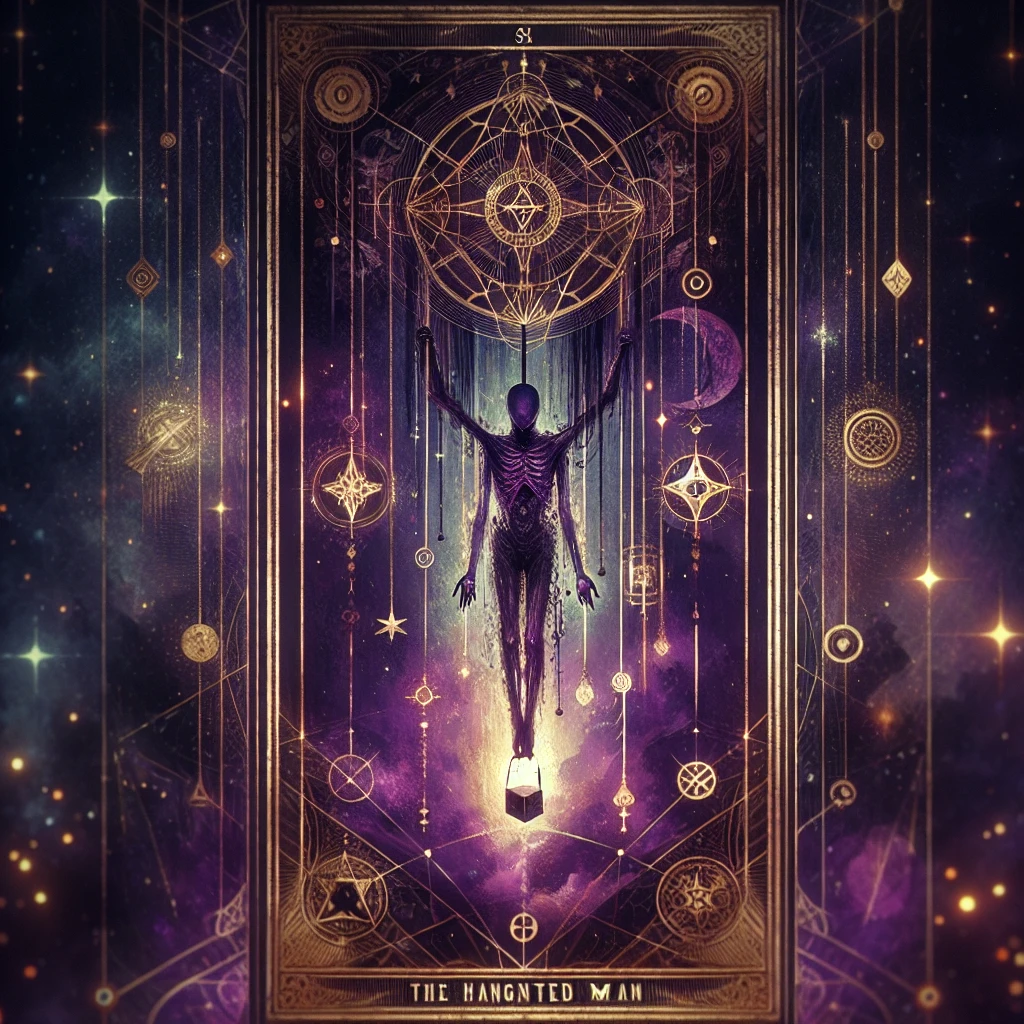
The Hanged Man across four decks
| Deck | Date | What the card shows |
|---|---|---|
| Visconti-Sforza | Milan, mid-15th century | A young man hanging upside down by one foot from a wooden frame, hands behind his back. The cards carry no titles. |
| Tarot de Marseille | 17th–18th century | Le Pendu, card XII: a figure hanging by one foot from a beam between two trimmed trees, legs crossed, hands hidden behind him. |
| Rider-Waite-Smith | London, 1909 | A man hanging by his right foot from a living T-shaped tree, the free leg bent to form a 4, hands behind his back, a halo around a calm face. |
| Thoth | Painted 1938–1943, published 1969 | Aleister Crowley's and Frieda Harris's version: a figure hanging from an ankh against a grid of green squares, with a serpent below. |
In fifteenth-century Italian cities, traitors, fraudsters and runaway debtors who could not be caught were sometimes painted upside down, hanging by one foot, on the walls of public buildings. These shaming pictures, the pittura infamante, were a punishment by reputation. Some early lists of trump cards call the card "the Traitor", and the first viewers of a Visconti deck would very likely have recognised the pose.
Over the following centuries the meaning softened. Later occultists, Éliphas Lévi among them, read the inverted figure as an adept who has turned away from ordinary values, and Waite and Pamela Colman Smith gave him a halo and a living tree instead of a gallows. The Golden Dawn assigned the card to the element of Water and the Hebrew letter Mem, and placed it on the path from Geburah to Hod. Modern astrologers often add Neptune. What began as disgrace became voluntary suspension: a man who has chosen to hang still, and sees the world differently because of it.
What The Hanged Man means
A deliberate pause: that is the core of The Hanged Man. The card describes a period when pushing forward does not work, and progress comes from stopping, letting go of control and looking at the situation from a different angle. Upright, the pause is useful and often brings insight. Reversed, it turns into stalling, indecision, or a sacrifice that achieves nothing.
- Upright: pause, surrender, a new perspective, waiting with purpose, letting go, sacrifice for a reason
- Reversed: stalling, indecision, resisting a necessary pause, pointless sacrifice, playing the martyr
- Number and Arcana: XII, Major Arcana
- Element and planet: Water; Neptune in modern astrology
- Yes/No: not now; wait
What does The Hanged Man mean upright?
Upright, The Hanged Man says the situation is in suspension and that this is not a failure. Some things cannot be hurried: approvals, other people's decisions, healing, a market that has not turned yet. Trying harder often makes them worse.
Think of a product team ready to launch, held up because the legal department wants to review the terms. Nobody on the team can speed up the review. The team can spend three weeks refreshing the inbox, or use the time to fix the onboarding flow everyone had been meaning to fix. The second choice is The Hanged Man used well: the pause is accepted, and something useful is done inside it.
The card's other theme is perspective. Many people have spent a day stuck on a problem, gone home, and seen the answer the next morning in the shower. Hanging upside down, the figure sees the world in reverse, and what looked like a dead end turns out to be a matter of angle. The card often appears when you are about to understand something that effort alone could not reach.
There can also be a sacrifice here, but a chosen one: giving up some income to study, turning down a project to protect time for a more important one, waiting to sign instead of grabbing the first offer.
What does The Hanged Man mean reversed?
Reversed, the pause loses its purpose, and that usually shows up as one of these:
- Stalling. You know what has to happen but keep waiting for a better moment that never arrives. The application stays in drafts for months.
- Resisting the pause. You force decisions while the situation still needs time, and every push makes things messier.
- Martyrdom. You give up more and more for a job, a team or a person, and resent it, but do not say so. The sacrifice no longer serves anything.
- The end of a pause. Sometimes the reversal is positive: the waiting period is over and movement is returning.
Ask yourself what you are waiting for and whether it is still coming. If you cannot answer, the reversed card suggests that the waiting itself has become the problem.
Cards often confused with The Hanged Man
The Hermit. Look at the hands. The Hermit holds a lantern up and walks a mountain path, so his card shows someone moving, slowly and alone, towards an answer. The Hanged Man's hands are behind his back and his feet are off the ground; he cannot go anywhere. An engineer who spends a month reading papers and calling experts to solve a design flaw is in Hermit territory. The same engineer told to stop all work until a supplier delivers a part is under The Hanged Man.
Four of Swords. Here a knight lies as a stone effigy on a tomb, hands together, in a quiet church. Everything about the image is stillness and stone. The Hanged Man hangs from a tree that is still growing leaves, and his face is alert. One is a card for switching off after a hard stretch; the other is for staying awake to a problem while you are unable to act on it. A practical test: if a week off would fix it, it is the Four.
Death. The card that follows, number XIII, is sometimes mixed up with it because both feel heavy, but in The Hanged Man nothing has ended yet and the outcome is still open.
What does The Hanged Man mean in love?
In love, The Hanged Man shows a relationship in a holding pattern. Neither moving forward nor ending, it waits: for a decision, a change of circumstances, or one person to see things differently. Long-distance couples waiting for a visa or a job transfer often recognise themselves in this card.
The upright card suggests the pause can be productive. It is a good time to look at the relationship from your partner's angle, or to ask what you would see if you stopped trying to control the outcome. Someone who is single may be in a phase of not dating by choice, rethinking what they want.
Reversed, the card warns against one-sided sacrifice: putting your life on hold for someone who is not doing the same, or waiting indefinitely for a person who keeps saying "not yet". If the waiting has no agreed end, the reversed Hanged Man suggests asking for one.
What does The Hanged Man mean for career?
In career readings, The Hanged Man often shows up during hiring freezes, delayed promotions, projects on hold or the gap between leaving one job and starting another. It advises against forcing the issue and in favour of using the time.
Someone in a company that has frozen hiring for a quarter, say, might use those months to earn a certification, document their achievements, or have quiet conversations about what they want next. When the freeze lifts, they are ready.
The card also suggests looking at your work from an unusual position. Ask how a client would describe your service, or how a new colleague would see your process. Upside-down thinking is often how stuck projects move again.
Money calls for patience under this card: not the moment for large purchases or risky investments. Reversed, it may point to a job you stay in out of inertia, or to a sacrifice of time and health for an employer that gives little in return. Tarot is no guide to physical recovery, so if the strain is showing in your body, that is a matter for a doctor.
Is The Hanged Man a yes or no card?
The Hanged Man means not now. It is closer to "wait" than to a clear no. The situation needs time, more information, or a change in how you see it before an answer makes sense. If you ask again after the pause, the answer may well be different.
For timing, it points to a delay with no fixed date. Things move once the perspective has shifted, not when a calendar says so.
FAQ
Is The Hanged Man a bad omen?
No. Despite the name, the card is not about death or punishment in modern readings. It describes a pause and a change of view. It can be frustrating, especially for impatient people, but it is rarely a sign of harm.
Why does the figure on The Hanged Man look so calm?
Because the suspension is voluntary in the Rider-Waite-Smith version. The halo around his head suggests insight, and the relaxed face shows acceptance. He is not struggling against the rope, which is the card's main lesson: resistance makes the position harder, while acceptance lets him see something new.
Is The Hanged Man connected to Odin?
Many modern readers link it to the Norse story in which Odin hangs for nine nights on the world tree, Yggdrasil, to gain knowledge of the runes. There is no evidence that the original card designers had this myth in mind, but the parallel of sacrifice in exchange for insight fits the RWS interpretation well.
What does The Hanged Man mean as a person?
It can describe someone in limbo: between jobs, between countries, waiting on an answer. It can also describe an unconventional thinker who sees what others miss because they look from a different position, or, reversed, someone who complains about their sacrifices but will not change anything.
Can The Hanged Man mean a project will be cancelled?
Not on its own. It describes a project on hold, not one that has been stopped, and the decision is still open. If it sits next to Death, Ten of Swords or Eight of Cups, cancellation becomes more likely; with Ace of Wands or Eight of Wands nearby, the work is more likely to restart once the hold lifts.