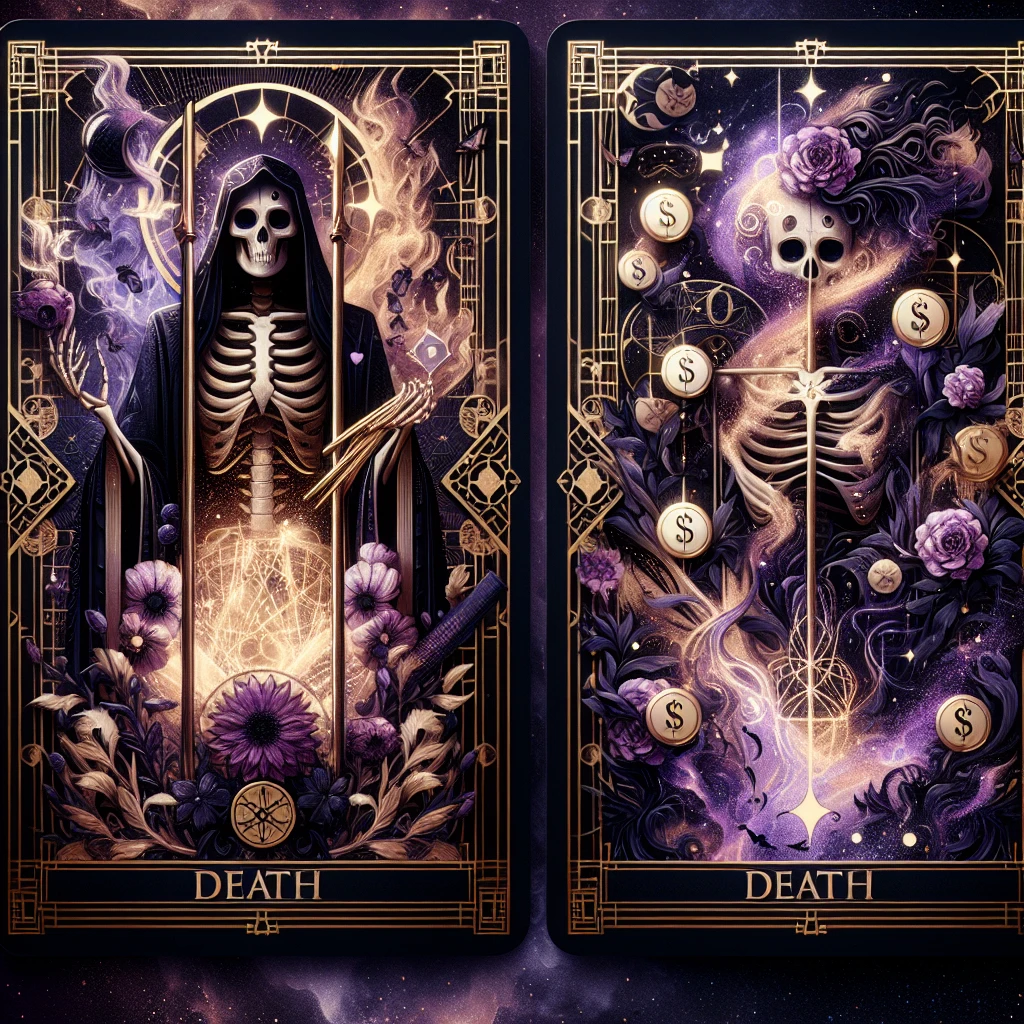
When the skeleton on a white horse turns up in a spread, the first question is almost always the same, so here is the plain answer: the card describes an ending, not a death. Card XIII describes a chapter that is finishing and cannot be extended, and that the space it leaves will be used by something else. Upright, the ending is already under way. Reversed, it is being resisted or dragged out.
- Upright: ending, closure, transition, letting go, clearing space for what comes next
- Reversed: resisting an ending, stagnation, a slow or stalled transition, fear of change
- Number/Arcana: XIII, Major Arcana
- Sign/element/letter: Scorpio, Water; Hebrew letter Nun (Golden Dawn)
- Yes/No: No to keeping things as they are; yes to closing a chapter
Does the Death card mean someone will die?
No. In modern tarot practice, Death is not read as a prediction of anyone's physical death, and responsible readers do not use it that way. The card is about endings in life: a job, a relationship, a home, a habit or a version of yourself. If a reading seems to say otherwise, the cards are being asked a question they cannot answer.
The fear is understandable. The card shows a skeleton, it is called Death, and it carries the number thirteen. But the image is a medieval allegory, not a forecast. The same picture shows a sunrise on the horizon, which tells you the story continues.
The same goes for health: a spread cannot diagnose anything or predict how an illness will go, so a real symptom belongs with a doctor, not with the cards.
What does Death mean reversed?
Reversed, Death usually shows an ending that is due but is not being allowed to happen. Three readings are common:
- Holding on. You keep paying for a gym you have not visited since spring, or keep answering an ex's late-night messages. Small things, but they show something finished being kept on life support.
- A slow transition. The change is happening, just more gradually than expected. A move that keeps slipping by a month, a role you are handing over piece by piece.
- Fear of what comes after. The ending itself is accepted, but the empty space is frightening, so you stall. The card asks you to let the gap exist for a while.
In each case the advice is the same: the ending will happen anyway, and resisting it mostly makes it longer.
What does Death mean as feelings?
As someone's feelings, Death shows that their emotions have changed in a deep way. Often it means they feel that something between you has ended, or that they no longer feel what they used to. It can also mean they are going through a big change themselves and are emotionally closed for now.
It is not always negative for the relationship. Sometimes the feeling is "the old way we related is over", which leaves room for a different, more honest connection. Look at the next card: a Cup or The Star suggests renewal, Swords suggest distance.
What does Death mean as a person?
As a person, Death describes someone in the middle of a major transition: just divorced, just moved, recently changed career or recovering from a loss. They tend to be serious, private and hard to read. They may also be the kind of person who ends things cleanly and does not look back.
Occasionally the card points to someone who is the agent of change in your life, such as a new manager brought in to restructure a department, or a friend who tells you the truth you have avoided.
What does Death mean in love, upright and reversed?
Upright, in a relationship. The current form of the relationship is ending. That may mean a breakup, but it can just as well mean the end of one stage: the end of long distance, the end of living apart, or the end of a pattern of arguing about the same thing. A couple who finally stop spending every Sunday at his parents' place may be living a small Death card.
Upright, if you are single. It shows a clean break with the past, often with an ex or with a way of choosing partners. You delete the old chat and notice you do not miss it. New love tends to come after this card rather than with it.
Reversed in love. It usually describes a relationship that has run its course but continues out of habit or fear: both people know, nobody says it. It can also show someone who cannot let go of a past partner and keeps comparing everyone new to them. The reversed card does not say "it will be saved"; it says the ending has not been completed yet.
What does Death mean for work and money?
One morning on the train you realise you will not be doing this job in a year. That quiet certainty is very much Death, and so are a dissolved team, a contract that is not renewed or a role that simply stops existing. It is also a common card for a career change you have chosen.
Financially, the card closes accounts, literally or not. It can mean ending one source of income or one way of handling finances: shutting down a side business, paying off and closing a credit card, ending a subscription you no longer use. Reversed, it shows money tied up in something that should have been closed already.
Yes or no, and how soon?
Asked whether something will stay as it is, Death answers no: "Will we get back together?", "Will this job last?" It answers yes if you ask whether something is ending or whether you should let it go.
For timing, Death is a process rather than a single moment. Scorpio season, late October to late November, is sometimes used as a seasonal pointer. More practically, the card says the ending has started or is close, and the transition takes as long as it takes. Reversed, the same process stalls: expect it to take longer than you would like.
How is Death different from The Tower and Ten of Swords?
All three are endings, and they are often confused. They differ in speed, cause and what comes after.
| Card | How the ending happens | What it feels like | What comes after |
|---|---|---|---|
| Death (XIII) | A natural end of a cycle, often gradual | Grief mixed with relief, a sense of closure | A new stage, once you let go |
| The Tower (XVI) | Sudden collapse, usually from outside | Shock, chaos, disbelief | Clearing of ground; rebuilding comes later |
| Ten of Swords | The final, painful point of something already over | Exhaustion, "it cannot get worse" | Rock bottom, so the only way is up |
With Death you walk out of a room that has already emptied. With The Tower the room comes down while you are still inside. Ten of Swords is the moment you finally stop pretending it can be saved.
What do the symbols on the Death card mean?
In the Rider-Waite-Smith deck, Death is a skeleton in black armour riding a white horse. The armour shows that the change cannot be stopped by force, and the white horse stands for purity of purpose. He carries a black banner with a white five-petalled rose, a sign of life and renewal inside the ending.
Before him a king lies fallen, his crown on the ground: the king's crown does not save him. A bishop in a mitre stands with his hands joined, facing the rider, while a young woman turns away and a kneeling child looks up at him without fear. They show different responses to change: acceptance, avoidance and innocence. Behind them a boat crosses a river, and on the horizon the sun rises between two towers, the same pair that reappears on The Moon.
In older decks such as the Tarot de Marseille, card XIII is often left without a name and shows a skeleton with a scythe in a field of heads and hands. The Golden Dawn assigned the card to Scorpio and the Hebrew letter Nun, and gave it the formal title "Child of the Great Transformers, Lord of the Gate of Death".
FAQ
What does Death mean in the past, present or future position?
In the past, it points to an ending that shaped where you are now. In the present, the change is happening right now. In the future, it shows an ending ahead, which gives you time to prepare and to choose how you close things. As the final card of a spread, it says the situation ends in its current form; the card after it, if you draw one, shows what replaces it.
Is Death a good or bad card?
Neither. It is hard because endings hurt, but it is also one of the most freeing cards in the deck. Its effect depends on whether you resist the change or work with it.
What does Death mean as advice?
Let it end. Stop renewing, repairing or waiting for something that has run its course, and close it cleanly so that the next stage can begin.
What does Death mean next to The Lovers?
The Lovers is a card of choice, so together they describe a decision that closes one option for good. Choosing one partner, city or offer means another door shuts, and Death says that door will not reopen.
Why is Death number 13?
Death is XIII in the Tarot de Marseille and in almost every deck since, and the number's unlucky reputation grew up separately from tarot. In numerology, 13 reduces to 4, the number of structure, which fits a card about one structure ending so that another can be built.